

 I thought I should write about one of the unique features of Vinyasakrama yoga keeping the multiple 100 hr Vinyasakrama programs in consideration.
My Guru Sri Krishnamacharya taught this system to me over several years and would call it Vinyasakrama which identity I use.
Sri Krishnamacharya refers to Vinyasas in at least two of his books viz., Yoga Makaranda and Yogasanangalu in Kannada.
Here is what he says in his book Yogamakaranda
“2.4 Important Observations
From ancient times, while doing Vedadhyayanam, thesvaras (the notes) udatta (elevated), anudatta (low) and Svarita (middle) in the aksharas (syllables) of the vedas are observed and mastered without fail; in music, the rules of sruti (pitch), layam (rhythm), dhrtam and anudhrtam are followed.
In pathyatmaha (verses of 4 lines each) poems the rules for chandas, yati, and parasam have been established and are carefully followed; in mantra upasana, the anganyasa, karanyasa, sariranyasa, kalaanyasa, matrukanyasa, jivanyasa tattvanyas are experienced and understood. Similarly in yogasana, pranayama and the mudras, the vinyasas handed down from ancient times should be followed.
But nowadays, in many places, these great practitioners of yogabhyasa ignore vinyasa krama and just move and bend and shake their arms and legs and claim that they are practising asana abhyasa.
 These strong words from Krishnamacharya written almost a century ago may have some relevance even in present times. In Vinyasakrama, he taught both static asanas and dynamic vinyasas. Vinyasas I learnt were various movements associated with specific asanas. Vinyasas prepare the body variously for achieving Asana siddhi or perfection in an intended Asana.
But one unique feature of his vinyasakrama teaching was breath orientation with the vinyasa movements. In fact on the first day he asked us – my family – to stand in samasthiti and the first movement was raising both arms overhead. Even before he gave the instruction for the movement he said in English “ Inhaaaaaaaaaaale” raise the arms. The first instruction was about breathing and then the instruction for the vinyasa movement. Since then I had studied with him for decades. Not a single vinyasa movement was taught without the appropriate breathing – synchronized inhalation or exhalation.
He would say the breathing should be controlled in the the throat (head down like in jalandhara bandha) with a hissing sound (a la cobra) and a slight rubbing sensation in the throat (I am using his words).
I had learnt some yogasanas in my school and a few other teachers but nobody taught the vinyasa or with any breathing. I was curious. Was there any reference to this in ancient texts or was it Krishnamacharya’s inventive genius?
One day I asked him about this breathing business. Where can I find any reference to it?
 After a moment’s pause he asked me and Desikachar to meet him in the evening. Then he mentioned reference to yoga sutras “prayatna saitilya…” and a few other obscure texts. Prayatna means effort and he implied that prayatna means breath or breathing. But in common usage prayatna is effort, but where does it say it is breathing? And almost all the contemporary books of yogasutras translate prayatna as effort one puts in, in doing the Asana.
I did a little research. Nyaya is a vedic sibling philosophy along with darsanas like yoga sankhya etc. Viswanatha, a renowned navyanyaya, defines prayatnam as threefold. Pravrithi or activities that one takes to get what one wants and nivritti or activities one undertakes to get rid of what one does not want are the two of them. The third is jivanakarana or jivanaprayatna or the effort to maintain life which is prana vritti.
‘“prayatnam trividam proktam, pravriii nivritti jivanakaranam”
So here prayatna is jivanaprayatna or pranic activity, especially breathing. It made sense. Prayatna in this sutra would be life effort or breathing.
According to Prasadtapada prayatna is of two types
-
Jivana- purvaka (innate activity to live/prana)
-
Icchadvesha-purvaka (activities arising out of desire or aversion)
There is more. My Guru had written a book “yogasanangalu” in Kannada. He had given me a copy. I did not read it as I did not know Kannada, but used to see his lovely Asana pictures in it. Later on, much after his lifetime, I saw an English translation for part of the book.
 There he mentioned Vinyasa. Here is the quote
“Vinayasas” many people are curious about its secret. Some others want to know its basis.
I agree.“प्रयत्नशैथिल्यानन्तसमापत्तिभ्याम्”
“prayatnashithilyanantasamapattibhyam”
Please see Patanjala yogasutra and Vyasabhasha (P 2, S 47) and Vachaspathi Misra in that commentary “सांसिद्धिकोहिप्रयत्नः शरीरधारको न योगांगस्योपदेश्टव्यासनस्य कारनम्। तस्मात् उपदेश्टव्यासनस्यायमसाधकः विरोधीच स्वाभाविकः प्रयत्नः। तस्य च याध्रुच्छिकासनहेतुतया सननियमोपहंत्यत्वात्॥
“Saamsiddhiko hi prayatnah shariradharako na yogangasyopadeshtavyasanasya kaaranam. Tasmat upadeshtavyasanasyayamashadhakah virodhi cha swabhavikah prayatnah. Tasya cha yadruchhikasanahetutayaa sananiyamopahamtyatvat.”
Translation:
The upholder of the body (sarira dharaka) is the samsiddhika prayatna or innate effort (prayatna) or prana. (Without prana the body collapses) This natural breathing is not the means to achieve the intended Asana but rather would be counterproductive. If natural (involuntary) breathing would accomplish asanasiddhi, there is no need to mention it here.
“तसात् उपधिश्टनियमासनम् अभ्यस्यता स्वाभाविकप्रयत्नशैथिल्यात्मा प्रयत्न अस्तेयः नान्यथा उपदिश्टं आसनं सिध्यतीति स्वाभाविकप्रयत्नशैथिल्यं आसनसिद्धिहेतुः।”“tasmat upadishtaniyamaasanam abhyasyataa svaabhaavikaprayatnashaithilyaatmaa prayatna asteyah naanyatha upadishtam asnam sidhyateeti svaabhavikaprayatnashaithilyam asanasiddhihetuh”
Translation:
Therefore the rule while practicing (vinyasa) for an intended Asana is to have breathing effort smooth (controlled). So, smoothening the breath (by voluntary control of the breath) is the means of attaining perfection of the intended (upadishta) asana
 Sri Krishnamacharya proceeds further on the emphasis on breath control in Asana vinyasas as follows:
“Therefore, how many breathings for which asana? When is inhalation? When is exhalation? In what way? When the body is stretched forward, inhalation or exhalation? What about when you raise your head?
To know this mystery and practice in order is called Vinayasa. These along with the significance of each asana will be discussed in 1 to 32”
Now for the second part of the sutra “ananta samapatti” Samapatti is the mental activity of focusing. But the mind is already engaged with the breath as sitila-prayatna. So the object of mental focus should also be connected with the breath. While studying with him, my Guru, would also mention that the breath should be controlled in the throat with a mild rubbing sensation and a hissing sound (a la cobra). Ananta is often associated with cosmic breath in some philosophical contexts. The word Ananta some say can be considered to be derived from the root ana-svase or ‘ana’ to breathe like in prana (pra+ana).
Ananta is usually translated as infinity. Many commentators say that one should focus on this infinity while trying to get into an Asana. It is easier said than done. What is infinity and how does one meditate or focus on it? Ananta could also mean Nagaraja the serpent Lord, the original form of Patanjali. So here it has to be one aspect of Nagaraja which is its breath. The serpents around Lord Siva’s neck are symbolic of the vayu tatva or air principle in Indian mythology. So the interpretation should be that one should make the breath smooth by voluntary control as per the first part of the sutra and the focussed breathing should be subtle like the breathing of a cobra, a subtle hissing sound, as per the second part
So what do we have now for the YS II 47?
 Do the vinyasas intended for a particular Asana with smooth controlled breathing. The movement-synchronized breathing would be like that of a cobra hissing, soft, smooth, barely audible to the person on the neighboring mat. The mind, breath and body parts work in unison.
The vinyasas pertaining to a particular Asana (uddishta Asana) may be classified into lead sequence vinyasas, preparatory vinyasas, vinyasas on the particular Asana, pratikriyas and return sequence vinyasas.
Navya-yoga or neoyoga has a number of new very complicated exciting asanas with sanskrit names, thanks to Google English- Sanskrit translator. Then we have standalone exciting but randomly selected ‘breathless’ vinyasa flows. But the traditional vinyasas were breath oriented, Asana specific. They were meant to be Asana facilitators.
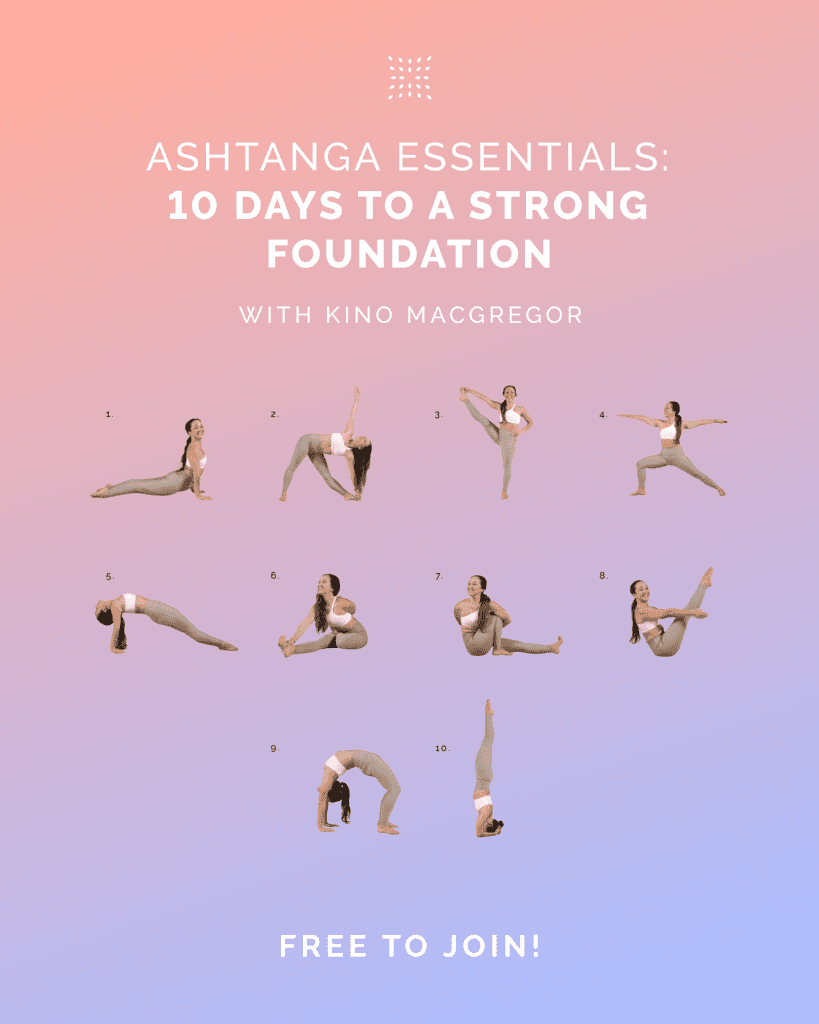
The asana portion in the 100 hr Vinyasakrama Yoga program will include 10 major sequences (4 seated, 3 standing, 2 lying down and 1 inversion) made up of scores of asana subroutines and hundreds of vinyasas, ten varieties of pranayama and introduction to dharana meditation.
The 100 hr program also includes detailed study of two important texts Sri Krishnamacharya taught, viz., Samkhya Karika and Yogasutras each for 20 hrs. I will write about them in the next monthly newsletter.
Editor’s Note:
Srivatsa Ramaswami’s 100-hour Vinyasakrama Teacher Training begins this May. The program is available both online through Omstars and in person at Miami Life Center. This immersive training offers a rare opportunity to study directly within the lineage of Sri Krishnamacharya, exploring asana, pranayama, and classical texts in depth.
You can learn more and register through Omstars or Miami Life Center.
Photos provided by Srivatsa Ramaswami’s article My Studies with Śrī Krishnamacharya.