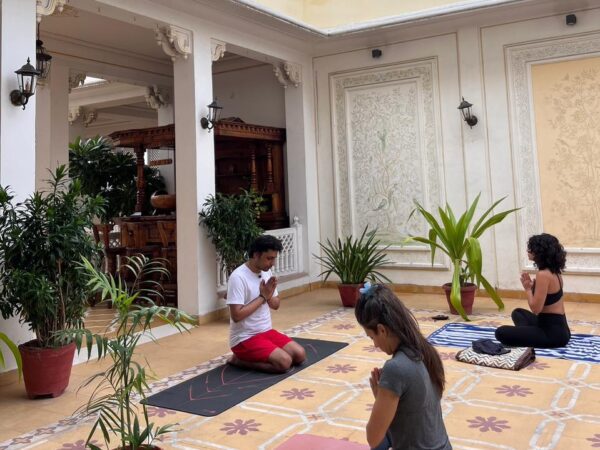


How yoga practice cultivates inner awareness, ethical clarity, and spiritual maturity beyond physical postures.
Yoga is more than stretching. Anyone who has practiced sincerely for even a year or two can feel this truth directly. The practice draws the senses inward, turning attention from the outer world toward the subtle terrain of the heart. What begins as movement becomes inquiry. What begins as effort becomes listening. In this inward turning, we encounter depths that are often wordless and difficult to communicate. Whether our practice matures into wisdom or dissolves into self-deception depends on how honestly we meet what we discover within.
The yogic tradition has always insisted that the real work is internal. Patañjali defines yoga as yogaś citta-vṛtti-nirodhaḥ (Yoga Sūtra I.2), the stilling of the fluctuations of the mind. When the mind becomes quiet, we do not become empty. We become capable of seeing clearly. The practice asks us not merely to discipline the body but to refine perception itself. In that clarity, conscience awakens.
We cannot measure another person’s practice by how deeply they stretch, how strong they appear, or how impressive their postures may be. Nor, ultimately, can we judge anyone at all. Each of us is the auditor of our own conscience. It may be possible to deceive others, but within the silent chamber of the heart truth remains unmistakable. One of my teachers once said that while we may try to justify ourselves to the world, at the very least we must remain honest with ourselves. There is no escaping the witness within. The Kaṭha Upaniṣad reminds us that “the Self is the silent seer, the inner controller, seated in the heart of all beings.” We may turn away, but the inner witness does not.
If our practice leads us toward division, anger, and hatred, then something in the practice has not yet ripened. Yoga is not merely technique. It is transformation. The Bhagavad Gītā describes the realized practitioner as one who is “free from malice toward all beings, friendly and compassionate, without possessiveness or ego” (Gītā 12.13). Where hostility grows, insight has not yet fully matured.
Strength and power, when cultivated through practice, are not meant to elevate oneself while diminishing others. True power uplifts. It moves like a rising tide that carries all beings forward together. The attempt to hoard power, to consolidate authority in one person or one place, reflects not spiritual maturity but the psychology of domination. Contemporary scholarship in psychology and leadership studies has increasingly shown that narcissistic and authoritarian dynamics often disguise themselves in moral or spiritual language. Yet the yogic tradition warned of this long ago. The Yoga Sūtra identifies asmitā, ego-identification, as one of the root afflictions (II.3), the subtle force that turns power into control and knowledge into self-importance.
Words reveal consciousness. Some words wound and divide. Others heal and connect. Early in my practice, a dear friend who had studied Buddhism for many years told me something that stayed with me. He said that what impressed him most about his teachers was their humility. Whenever he praised them, they redirected the praise to their own teachers or to others in the community. They refused to position themselves as the sole authority. Their humility dissolved ego rather than reinforcing it. I took that lesson deeply to heart. Spiritual practice is never about one person, nor is it a competition to stand at the top of some imagined spiritual hierarchy. We walk together along the same path toward the same timeless reality. The Īśa Upaniṣad declares, “He who sees all beings in the Self and the Self in all beings never turns away from it.” At the level of spirit, division dissolves.
When spiritual leaders use their influence to speak words of hostility toward others, especially toward those who are suffering, it signals not clarity but blindness. This is not condemnation. It is a call to continue practicing. Each of us has blind spots. Each of us can be misled, manipulated, or caught in patterns we do not fully see. Contemporary trauma and social psychology research reminds us how easily human beings can be drawn into systems of influence, especially when identity, belonging, and moral certainty are involved. Awakening from illusion is rarely comfortable. It often comes with grief, disorientation, and the painful recognition that someone we trusted may not have embodied the values we believed.
Yet the practice prepares us for precisely this moment. Yoga cultivates the courage to see clearly, not only through the distortions of others but through the illusions of our own mind. The Muṇḍaka Upaniṣad says, “Truth alone triumphs.” What is hidden in darkness eventually comes to light. Awakening can be frightening, but it is also liberating.
We live in a time of profound upheaval and transformation. In such times, silence is not always neutrality. Sometimes silence protects harm. The yogic path is often described as inward, but it is not a withdrawal from responsibility. The Bhagavad Gītā teaches lokasaṅgraha, action for the welfare of the world (Gītā 3.20). Spiritual realization does not end in isolation. It returns to the world as service.
Power at its highest calls others inward, toward truth and unity. Power at its lowest divides, labeling some as righteous and others as enemies, reinforcing separation and fear. When language becomes consistently hostile toward perceived rivals or outsiders, it departs from the heart of yoga.
Consider the story of Arjuna. Standing on the battlefield, he is prepared to fight, yet he is instructed to act without hatred. This is spiritual strength of the highest order. The Gītā does not glorify violence. It reveals the possibility of acting with clarity while remaining free from enmity. Hatred is easy. Clarity without hatred requires profound inner stability.
History shows that systems of domination thrive when people are divided, when fear replaces understanding, and when hostility replaces dialogue. But when we call one another inward toward truth, compassion, and shared responsibility, collective strength emerges. Yoga, at its deepest level, is the recognition of unity. Not sameness, but interconnectedness.
We are stronger together. We always have been. And the practice continues to call us toward that truth.