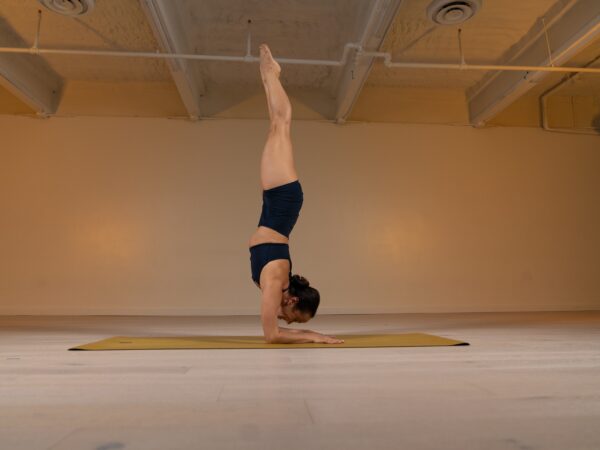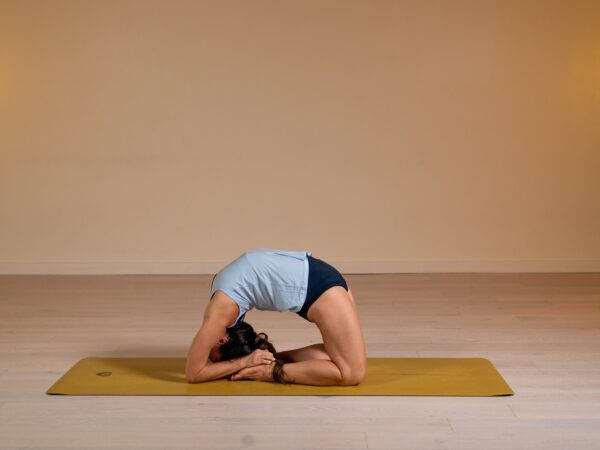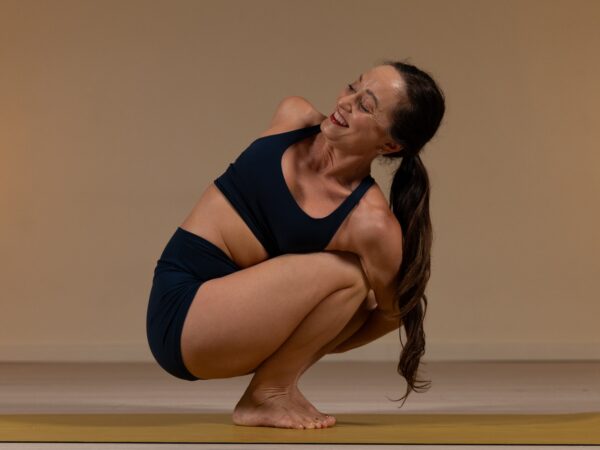

For a long time, straddle and middle splits felt like the last unmapped territory of my body. I could move deeply in many directions: forward bends that folded me inward, backbends that opened my heart, twists that wrung me clean. But this space, the wide opening of the hips into the middle line, resisted me. It was humbling.
There were years when I wondered if something about my bone structure simply made this impossible. I studied my hips, compared myself to others, questioned anatomy, lineage, even effort. Yet slowly, almost imperceptibly, something changed. Not all at once. Not dramatically. But over time, through patient practice and repeated return, the body softened where it once held. Strength appeared where there had been only resistance. What once felt closed and unreachable became familiar, even friendly. The frontier did not vanish, but it opened.
Straddle has taught me that difficulty is not a verdict. It is a conversation. Sometimes a long one.
Samakonasana and the Language of Balance
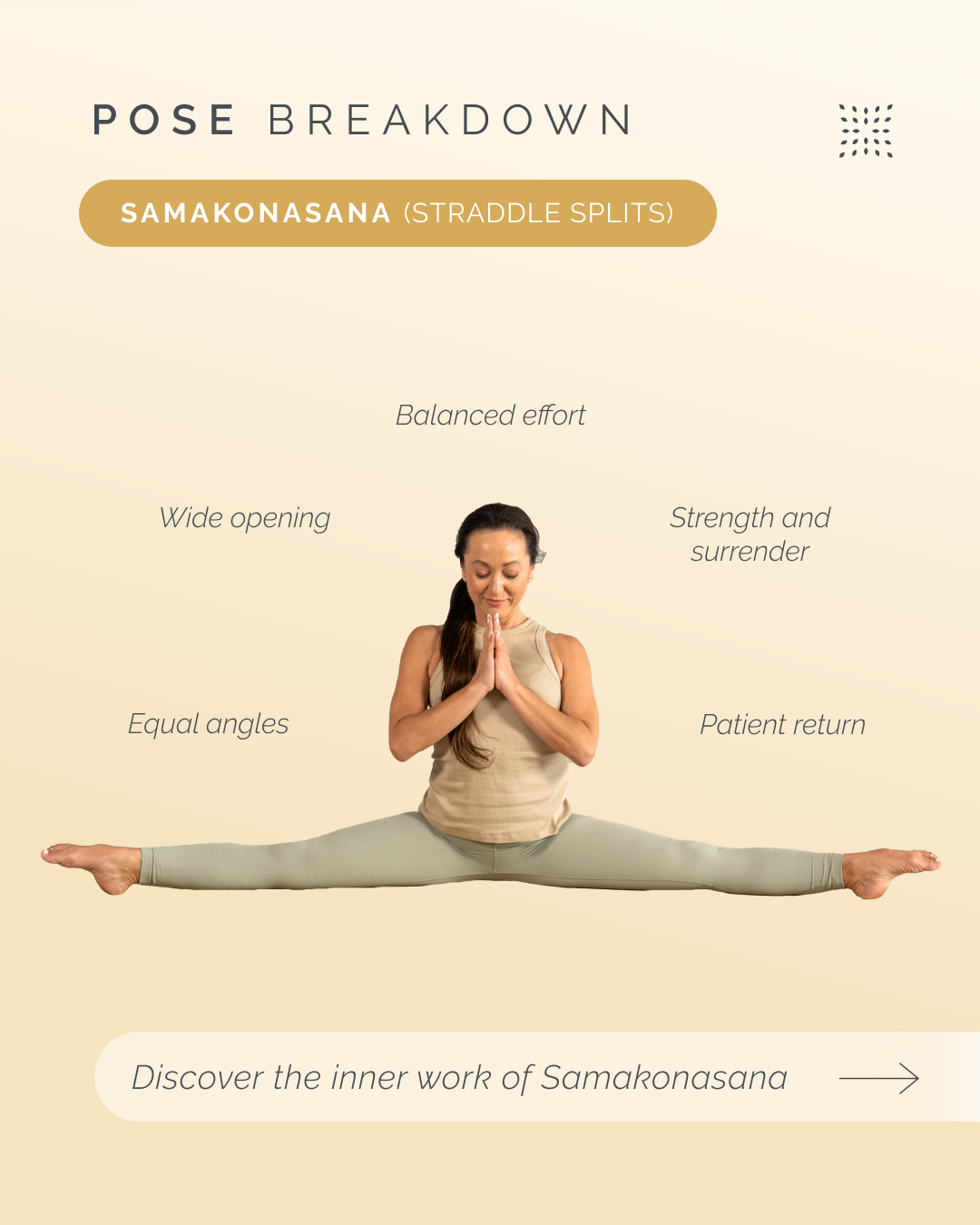
Samakonasana is a simple name that hides its depth. Sama means equal, even, balanced. Kona means angle. Asana is the seat or posture. Samakonasana is the posture of equal angles, the body opened symmetrically from a central axis.
There is no forward escape here, no backward bend to lean into, no twist to redistribute sensation. The body meets itself evenly. This symmetry is demanding. It asks for honesty.
Historically, Samakonasana appears in the later phases of the yogic repertoire, particularly in advanced practice sequences that assume a mature relationship with both strength and surrender. While there is no single mythic story attached to this posture in the way there is for warrior or sage poses, its symbolism is unmistakable. The yogic imagination often associates balance with cosmic order, with ṛta, the underlying harmony that sustains the universe. To open equally in both directions without collapse or strain is to embody that order in the body.
Energetically, Samakonasana is often associated with the balancing of samana prana, the inward moving current that governs digestion, assimilation, and integration. In straddle, energy is neither rushing upward nor draining downward. It gathers at the center. The pose demands that we stay present with sensation without dispersing attention. This quality of gathering is subtle, but it is essential. Without it, the posture becomes either aggressive or passive, neither of which leads to true opening.
The Penultimate Threshold in Fourth Series
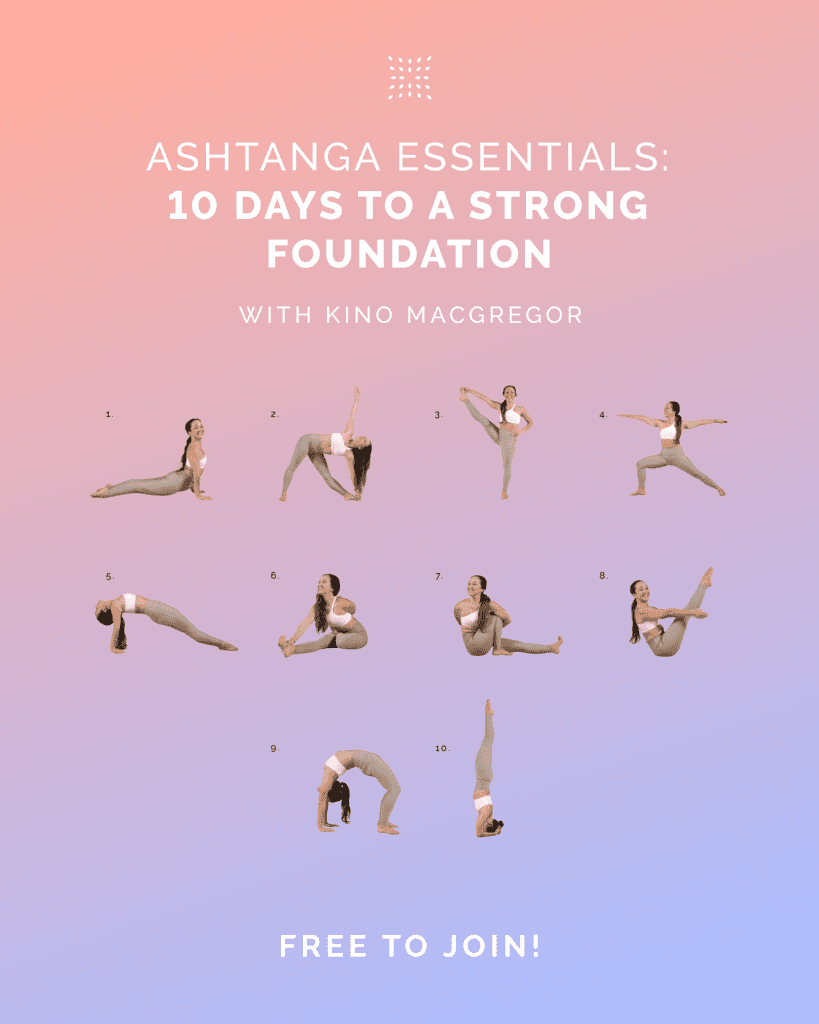
In the Ashtanga system, Samakonasana appears near the end of the Fourth Series, placed as the penultimate posture. This is not accidental. By the time the practitioner arrives here, the body has been shaped by years of methodical work. Earlier konasana forms have already prepared the hips through external rotation, internal rotation, flexion, and extension.
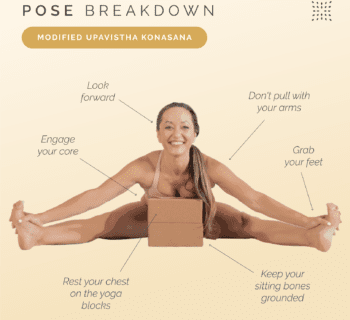
Supta Konasana, Baddha Konasana, Upavistha Konasana, and their many variations gradually teach the nervous system that opening does not require collapse. Each of these poses introduces a piece of the puzzle. Samakonasana asks for all of them at once.
Placed so late in the sequence, the posture functions as a threshold. It is not a dramatic finale. It is quiet, exposing, and exacting. There is no momentum to rely on. Only integration. The practitioner must arrive with enough strength to protect the joints and enough softness to allow depth. In this way, Samakonasana becomes less about flexibility and more about maturity of practice.
Straddle Across Yoga Traditions
Different styles of yoga approach straddle through different philosophies. In some traditions, the pose is emphasized early and held passively for long durations, with the belief that time alone will open the tissues. In others, straddle is approached dynamically, moving in and out of depth with muscular engagement. Still others avoid it almost entirely, wary of its demands on the hips and knees.
What distinguishes the Ashtanga approach is not the depth of the shape, but the integration of effort and release. The posture is not something to be endured, nor something to be conquered. It is something to be inhabited. When approached with intelligence, the pose becomes less extreme and more expressive. The goal is not maximum range, but balanced range that can be supported and sustained.
Straddle Beyond Yoga
Outside of yoga, straddle is foundational in contortion, dance, and gymnastics. In these disciplines, the posture is often pursued early and aggressively, sometimes with impressive results and sometimes at significant cost. Dancers use straddle to access expansive movement and expressive lines. Gymnasts rely on it for power generation, aerial control, and precision. Contortionists push the range far beyond what most yoga practitioners ever attempt.
What is often missing in these contexts is the inward awareness that yoga cultivates. The focus is frequently external, oriented toward shape, performance, or achievement. Yoga offers a different lens. It asks not only how far the legs open, but how the spine responds, how the breath moves, how the mind reacts to discomfort. When these elements are integrated, the pose becomes sustainable rather than spectacular.
How to Work with Straddle
Straddle responds best to a multifaceted approach. Passive stretching alone may increase sensation but often fails to create lasting change. Active stretching introduces muscular engagement, teaching the body how to support its own range. Assisted stretching can help reveal pathways, but only when applied with sensitivity and consent.
Long holds cultivate patience and nervous system adaptation, while shorter holds build strength and responsiveness. Contract relax methods, where the muscles are gently engaged and then released, can be especially effective when done with breath awareness. Mobility work, moving in and out of range rather than settling at the edge, helps the joints feel safe.
Above all, strengthening must accompany stretching. The adductors, abductors, deep rotators, and core musculature all play critical roles. Without strength, flexibility becomes fragile.
Straddle is not improved by forcing. It is improved by listening repeatedly and responding skillfully.
When to Be Cautious
Straddle is not appropriate for everyone at every stage. Hip labral injuries, sacroiliac instability, chronic groin strains, and certain knee conditions warrant caution or modification. Pain that feels sharp, electric, or destabilizing is not productive. Sensation can be intense without being harmful, but discernment is essential. Progress in this posture should feel incremental and integrated, not abrupt or dramatic.
The Meaning of the Wide Open Space
Straddle has taught me that openness is not the absence of resistance. It is the willingness to stay present with it. This posture has asked me to confront comparison, impatience, and doubt, and then to practice anyway. Over time, the body responded, not because it was forced, but because it was trusted.
In the end, Samakonasana is not about how wide the legs go. It is about balance. Equal effort. Equal listening. Equal respect for strength and softness. The final frontier is not the hips. It is the mind that believes difficulty means impossibility. When that belief softens, the body often follows.
Practice This on Omstars
If you want to explore straddle with intelligence, strength, and patience, I have a dedicated collection of Straddle-focused classes on Omstars, along with the 30 Day Flexibility Challenge, which builds sustainable range through active mobility, strength, and breath-led practice.
These classes are designed to support opening without forcing, and to help you develop a relationship with straddle that is stable, integrated, and embodied.