
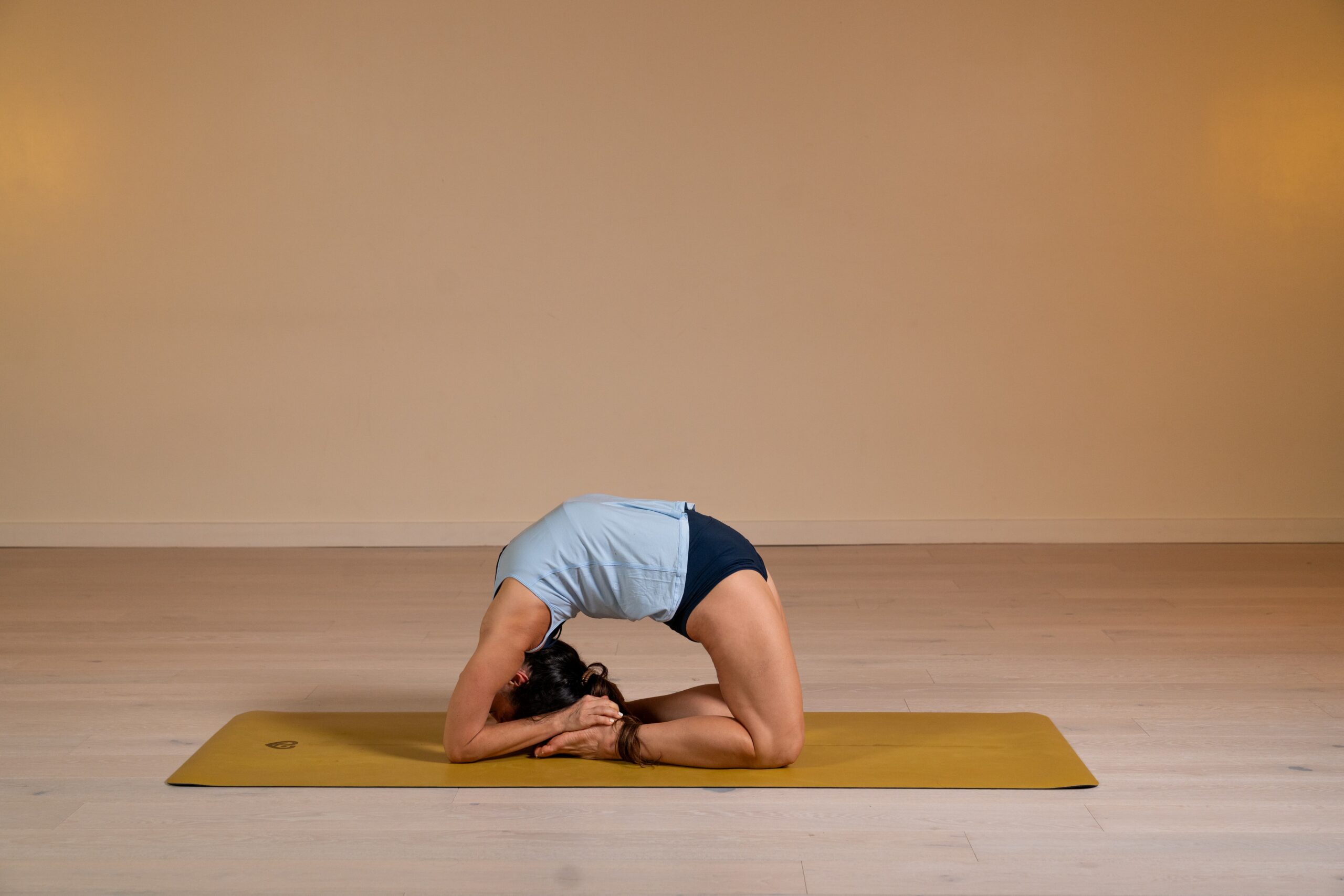
There is perhaps no backbend more iconic in the Ashtanga Yoga practice than Kapotāsana. For many practitioners, the very mention of the pose evokes a curious mixture of excitement, apprehension, fascination, and respect. It has acquired an almost mythical reputation, passed from student to student through stories of triumph, frustration, years of patient effort, and moments of profound transformation. Some people approach it with confidence, others with dread, but very few arrive at it without already having formed an opinion about what it represents.
The Sanskrit name itself offers an interesting doorway into understanding the pose. Kapota (कपोत) most commonly means “pigeon” or “dove,” while āsana simply means seat or posture. The familiar English translation, Pigeon Pose, is therefore a literal rendering of the Sanskrit. Yet, as with so many Sanskrit words, kapota carries a broader symbolic world than its English equivalent can fully express. In Indian literature, pigeons and doves are often associated with gentleness, devotion, fidelity, and surrender. There are also traditional accounts of a sage named Kapota, whose name appears in the Purāṇic and epic traditions, remembered for his simplicity, humility, and unwavering dedication to spiritual life. Whether the posture was named directly after the bird, the sage, or because later commentators perceived a resemblance to both, it is difficult to say with certainty. Sanskrit names often preserve several layers of meaning simultaneously, allowing the practitioner to contemplate both the visible shape of the body and the qualities of consciousness that the name evokes.
Long before I understood anything about subtle anatomy, energetic integration, or the deeper purpose of practice, I remember seeing advanced students practicing Kapotāsana and immediately thinking that I wanted to try it. I did not yet know that it was supposed to be frightening. My younger, wonderfully naïve mind simply thought it looked like fun. Looking back, I am grateful for that innocence because fear had not yet become part of the equation.
I was fortunate to be surrounded by an extraordinary community of dedicated practitioners. Every morning there were students whose practice inspired me simply by their consistency and willingness to show up day after day. They were not trying to impress anyone. They were simply practicing, and that quiet dedication created an atmosphere where difficult things seemed possible.
Eventually I reached the preceding posture, Laghuvajrāsana, which is itself no small accomplishment. One morning I managed to come back up successfully and, feeling curious, I asked the teacher leading the Mysore room whether I could try Kapotāsana.
He smiled and said, “Sure. Knock yourself out.”
Only much later did I discover the deeper meaning behind that smile. At the time, I had no idea that Kapotāsana had been an exceptionally difficult posture for him, that he had wrestled with it for years, and that the pose had demanded from him a kind of internal surrender that was every bit as challenging as its physical requirements. His encouragement was genuine, but it also carried the wisdom of someone who already knew that the journey was never about catching the heels.
To my surprise, I did not knock myself out. In fact, on my very first attempt I managed to catch my heels and stay there for five breaths. Yes, I know. Please do not hate me.
That story has followed me for years, and while it often surprises people, it has also become one of the clearest examples I know of why the external shape of a posture tells us almost nothing about the depth of the yoga taking place within it. Just because I could perform the outward form of Kapotāsana did not mean I understood Kapotāsana.
I was not yet grounded in the pose. I had not yet learned how to organize my spine efficiently, how to distribute the extension evenly throughout the body, how to breathe without resistance, or how to perceive the subtle energetic changes that arise when body, breath, and mind begin to move together. The external architecture appeared almost immediately, but the internal practice required many years of patient repetition. In many ways, it is still unfolding. This distinction is one of the most important lessons yoga continually teaches us.
The posture itself is never the yoga.
Yoga is not simply arranging the body into increasingly elaborate geometric forms. Rather, the physical posture becomes a vehicle through which awareness deepens. Breath, body, and mind gradually unite into a single field of attention, allowing prāṇa to move more freely through the subtle energetic pathways known as the nāḍīs. Without this inner participation, the pose remains little more than an impressive shape. Beautiful perhaps, difficult perhaps, even athletic perhaps, but the transformative dimension remains largely untouched.
The postures were never intended to become trophies that we collect or accomplishments that define our worth. They are instruments of perception. They refine our ability to observe ourselves with increasing honesty, and through that observation they gradually become portals into dimensions of experience that cannot be reached by physical flexibility alone.
For this reason, Kapotāsana deserves both reverence and humility, even for practitioners who happen to possess the strength or flexibility to perform it with relative ease. Once a posture enters the Ashtanga sequence, it ceases to be something we accomplish once and becomes something we meet again every day that we step onto the mat. There is an enormous difference between doing a pose once and maintaining a relationship with it over decades. Our bodies change. Our nervous systems change. Our breath changes. Our emotional lives change. Consequently, the posture itself changes. What seemed effortless one year may feel completely inaccessible the next, while moments that once felt impossible gradually soften into familiarity.
Practice reveals that the pose is never fixed because we ourselves are never fixed.
Kapotāsana is sometimes described as a gateway posture. There are teachers who traditionally ask students to remain with this posture for an extended period before continuing deeper into the sequence, believing that its physical and energetic lessons deserve time to mature before additional complexity is introduced. Stories abound of dedicated practitioners spending years, sometimes decades, patiently working with Kapotāsana before receiving the next posture.
While I do not personally believe that enthusiastic and well prepared students should automatically be prevented from exploring the next stages of practice, I do understand the intelligence behind lingering here for a little while. Certain postures possess a depth that cannot be hurried. If we immediately modify the experience or quickly move on in search of the next achievement, we may miss what this particular posture is actually attempting to teach us.
At the same time, the opposite mistake is equally dangerous. If we convince ourselves that spiritual realization will somehow arrive the day we finally catch our heels, we risk sacrificing our physical health, emotional balance, and psychological well being in pursuit of an illusion. No external posture has ever guaranteed enlightenment. The body can become remarkably capable while the mind remains deeply attached.
Somewhere between impatience and obsession lies a healthier path. That middle way asks us to work diligently without becoming consumed by the outcome, to honor the discipline of daily practice while remembering that the deepest transformations rarely occur according to our preferred timeline.
From an anatomical perspective, Kapotāsana asks us to integrate nearly everything we have already learned about healthy spinal extension.
The foundation begins, as it almost always does, with the legs. The knees should remain approximately hip width apart, or slightly wider depending upon the individual proportions of the practitioner, while the thighs remain active and stable. The positioning of the pelvis carries forward the same organizational principles cultivated in Uṣṭrāsana and Laghuvajrāsana. Before attempting to travel deeper into spinal extension, the legs must create an unwavering base capable of supporting the entire movement.
From there, the pelvic floor gently lifts, the lower abdomen draws inward toward the spine, and the center line lengthens upward, creating as much space as possible between the pelvis and the rib cage. This upward lift is not incidental. It is one of the primary mechanisms through which the vertebral bodies are encouraged to decompress as the spine extends. Ideally, spinal extension creates greater spaciousness between the vertebrae rather than compressing them together. If the front body refuses to lengthen or if the deep support of the pelvic floor remains absent, the lumbar spine is often asked to absorb forces it was never designed to carry alone.
A true backbend is created by simultaneously lengthening the front body while strengthening the back body. The abdominal wall elongates, the spinal extensors engage, and the natural double S curves of the standing spine gradually reorganize into a long, continuous C curve. It is here that many practitioners unknowingly encounter one of the most common technical misunderstandings in backbending.
The instinctive response is often to squeeze the gluteal muscles as soon as the body begins to lean backward. Timing, however, matters enormously. If the gluteal muscles contract before the spine has fully lengthened into extension, they frequently drive the pelvis into excessive posterior tilt, tucking the tailbone underneath the body and limiting the very movement the practitioner is attempting to cultivate. A prematurely tucked pelvis often localizes the extension into one or two lumbar segments instead of allowing the curve to distribute evenly throughout the thoracic and lumbar spine. The gluteal muscles are not the enemy of backbending. Quite the opposite. Once the spine has elongated and the C curve has been established, the gluteals provide valuable structural support, reinforcing the strength of the legs and stabilizing the pelvis as the body continues deeper into extension. The distinction is not whether they engage, but when.
The relationship between the shoulders and the thoracic spine presents another subtle but enormously important aspect of Kapotāsana. Many practitioners reach their arms overhead before the spinal extension has fully developed. When this happens, the body often resembles more of an L shape than a C shape, hinging almost exclusively at the lumbar spine while the thoracic spine remains relatively immobile. Reaching overhead too early frequently increases compressive forces through the lumbar vertebrae while simultaneously restricting the ability of the rib cage to continue lifting.
If, however, the spinal curve is established first, the entire experience changes. As the sternum continues to rise away from the pelvis and the thoracic spine begins to participate fully, the arms may then externally rotate overhead, the elbows gradually drawing toward one another while the shoulder blades descend along the back before naturally assisting the lift of the thoracic spine. Even the upper trapezius assumes its appropriate supportive role, allowing the cervical spine to remain spacious rather than collapsing into compression. Sometimes the difference between feeling expansive in Kapotāsana and feeling as though one cannot breathe lies almost entirely in the sequencing of these actions.
Throughout the practice of this posture, specificity of perception becomes indispensable. It is rarely sufficient simply to say, “I feel my back.” Which structures are being loaded? Which muscles are working? Where is the stretch occurring? Where is the support arising? Can we distinguish the muscular effort alongside the spine from sensation arising within the vertebral joints themselves?
The thighs will often burn as they support the considerable weight of the torso. The abdominal wall may experience an intense but healthy lengthening. The shoulders, chest, and the tissues beneath the arms may feel a profound opening. None of these experiences are inherently problematic. Sharp pinching within the sacroiliac joints, compression within the lumbar spine, discomfort along the cervical vertebrae, or painful impingement around the shoulders are different conversations altogether.
One of the most valuable forms of intelligence a practitioner can cultivate is the ability to distinguish between the honest intensity of muscular effort and the unmistakable signal that a joint is being compressed beyond its healthy capacity. That discernment becomes one of the great gifts of long term practice because it extends far beyond Kapotāsana into every posture, every movement, and eventually into the way we learn to inhabit our lives.
The energetic dimension of Kapotāsana is equally compelling, although it is perhaps even more difficult to describe with precision. Many practitioners report powerful emotional responses arising either during the posture or hours afterward. Others describe waves of heat, internal vibration, tingling, or currents of energy that seem to move through the body in unfamiliar ways. Sometimes nothing remarkable seems to happen at all. Each and every one of these experiences belong.
The purpose is never to manufacture a particular sensation or to become attached to recreating an experience we once had. Some energetic phenomena appear only once in a lifetime. Others return repeatedly over many years. Still others evolve so gradually that we only recognize the transformation by looking backward. The practice asks only that we remain present, observing whatever arises with the same meditative steadiness that accompanies every breath.
As awareness becomes increasingly refined, we begin to recognize that the true work of Kapotāsana is not contained in the dramatic arc of the spine but in the quality of attention we bring into that arc. The body opens, certainly, but so too does perception. Breath enters spaces that once felt inaccessible. Mind becomes capable of remaining present under increasing intensity. The boundary between physical effort and meditative awareness begins to soften, and somewhere within that meeting place the posture quietly becomes Yoga.
No matter where you find yourself in your own relationship with Kapotāsana, whether you are dreaming of trying it for the first time, patiently working toward your heels, or have practiced it daily for decades, my hope is that you continue to discover not only how to perform the posture more skillfully, but how to inhabit it more deeply. In the end, that has always been the greater invitation. The shape may eventually come and go, as all physical forms inevitably do, but the awareness cultivated through sincere practice has the capacity to remain long after the body itself has changed.