
What does it mean to be a hero?
On the yogic path, this question quietly reshapes itself the longer we practice. Heroism is not measured by dramatic feats, visible strength, or outward conquest. Yoga invites a subtler inquiry, one that asks how we meet difficulty when no one is watching, how we respond to discomfort without fleeing, and how we cultivate steadiness in the midst of uncertainty.
Each time we step onto the mat, we enter a version of this inquiry. Practice becomes a lived metaphor for the hero’s journey, not as a tale of triumph, but as a descent into self-knowledge. In myth, the hero must descend into the underworld before returning transformed. In yoga, this descent happens internally, through the willingness to face restlessness, fear, and resistance with honesty and care. What we bring back is not victory over others, but wholeness within ourselves.
The Meaning of Vīrāsana
Vīrāsana, Hero Pose, gives physical form to this inward journey.
The Sanskrit word vīra means hero or warrior, one endowed with courage and vitality. Its root carries a sense of excellence and radiance that arises not from aggression, but from clarity of purpose. Āsana means a seat, a place where one abides. Vīrāsana, then, is not the posture of the hero in battle, but the seat of the hero at rest.
Unlike the standing warrior postures that emphasize expansion and outward expression, this seated form embodies collected readiness. The body kneels close to the earth, the spine rises naturally, and the breath steadies. Strength is present, but it is quiet and contained. The hero here is not asserting dominance, but cultivating composure, poised between action and contemplation.
Mythic Resonance: Strength with Humility
There is a subtle mythic resonance woven into this posture that deepens its meaning.
Hanumān, often honored as Vīra Hanumān, is revered for his immense strength, fearless action, and unwavering devotion. Yet his heroism is inseparable from humility. He is both dāsa, the devoted servant, and vīra, the courageous hero.
Vīrāsana reflects this union. The posture requires the body to bow close to the ground even as the heart lifts and the spine lengthens. It asks us to hold power without arrogance and devotion without collapse. On a physical level, the opening of the quadriceps and knees prepares the body for deeper expressions such as Hanumānāsana, yet the symbolic connection runs deeper still. Strength and surrender are not opposing forces. In mature practice, they arise together.
Vīrāsana in Classical Yoga
Historically, Vīrāsana belongs to a lineage of seated postures intended to support sustained inner work rather than display.
Classical haṭha yoga texts describe it as a stable and comfortable seat suitable for meditation and breath regulation. The Haṭha Yoga Pradīpikā includes Vīrāsana among postures that cultivate steadiness and ease, emphasizing its capacity to support concentration rather than athletic achievement.
In these early contexts, the heroism associated with the posture refers not to physical prowess, but to the courage required to remain present with the mind. To sit without distraction, to endure subtle discomfort, and to witness one’s inner patterns clearly was understood as a profound discipline.
Lineage Expressions of the Pose
As yoga evolved across lineages, Vīrāsana took on different pedagogical expressions while retaining its essential intent.
In Iyengar Yoga, the posture becomes a study in precision and patience. Props are used intelligently so the spine can rise effortlessly while the knees and ankles remain protected. Alignment is not pursued for aesthetic ideals, but as a means of cultivating intelligence within the body.
In traditional haṭha and Krishnamacharya-influenced systems, Vīrāsana is often taught as an appropriate seat for prāṇāyāma and meditation. The grounding of the shins and knees stabilizes the pelvis, allowing the breath to settle naturally in the abdomen.
In Ashtanga Yoga, Vīrāsana appears only in the Fourth Series, Advanced B, and is entered through a demanding articulation of the spine. The feet are flexed rather than pointed, introducing a deeper element of containment. This variation is paired with Paryaṅkāsana, Couch Pose, which distinguishes the neutral spine from the arched expression. Heroism here is discipline matured through patience and long-term commitment rather than quick attainment.
Across all approaches, the paradox remains the same: true steadiness arises when effort dissolves into ease.
How to Enter Vīrāsana (Hero Pose)
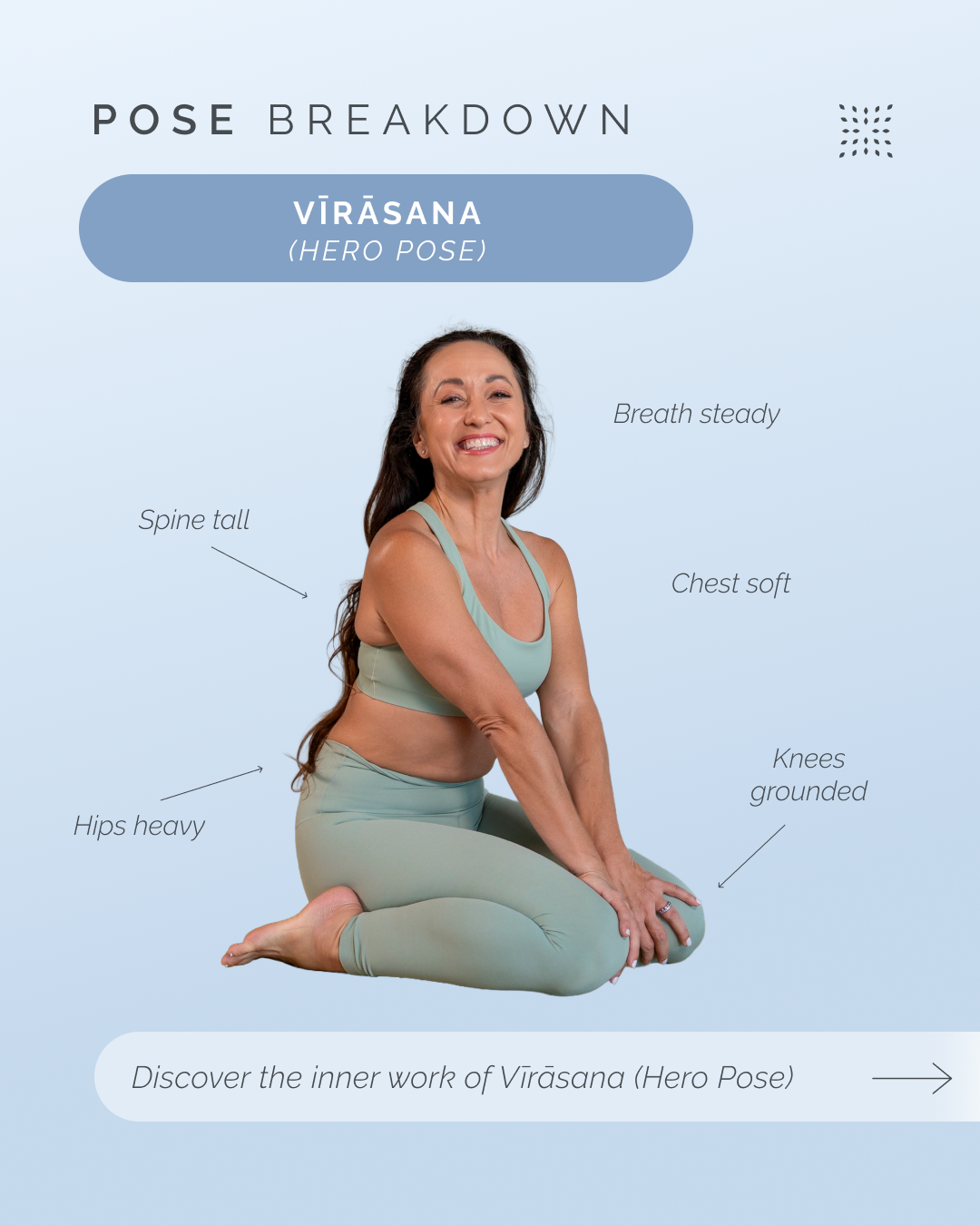
Begin by kneeling on the floor with the knees together and the feet slightly wider than the hips. The tops of the feet rest on the ground, with the big toes angled slightly inward.
Slowly lower the hips toward the space between the heels. If the sitting bones do not reach the floor comfortably, place a block, bolster, or folded blanket beneath the pelvis. Support allows the spine to rise naturally without strain.
Once seated, lengthen upward through the spine, allowing the shoulders to soften and the chest to open without effort. The hands may rest on the thighs or in the lap. The breath should feel steady and unforced.
If there is discomfort in the knees, ankles, or feet, elevate the hips further or practice with one foot forward at a time. Sensation is expected; pain is not. Intelligent support preserves the integrity of the joints and allows the posture to become sustainable over time.
Heroism Beyond the Mat
The symbolic dimension of the hero extends beyond posture into daily life.
The Bhagavad Gītā opens with Arjuna immobilized by doubt. Standing on the battlefield, overwhelmed by the consequences of action, he turns to Kṛṣṇa for guidance. Kṛṣṇa responds with one of yoga’s most enduring teachings, describing yoga as yogaḥ karmasu kauśalam, skill in action.
This skill is not cleverness or worldly success, but the ability to engage fully without being wounded by one’s own actions. To act with clarity, without becoming entangled in fear or attachment, is deeper mastery. Vīrāsana gives this teaching a bodily form. The posture asks us to remain composed in the midst of intensity, to stay present without tightening, and to cultivate discernment through stillness.
Stillness as Courage
Practicing Vīrāsana is not about enduring pain or proving resilience. Discomfort in the knees or ankles is not a badge of honor, but a signal inviting intelligent response. Support is not a concession, but an expression of wisdom.
As a meditative seat, Vīrāsana offers a rare balance between grounding and alertness. The body is stable without becoming heavy, upright without rigidity. The nervous system settles without dullness. This quality of calm readiness is essential not only for seated meditation, but for navigating life with clarity and grace.
Ultimately, the difference between merely sitting and practicing Vīrāsana lies in attention. When the posture becomes routine, the body may be still while the mind wanders. When it becomes ritual, each breath is infused with presence.
To sit in Vīrāsana is to embody a flame that neither flickers nor consumes itself. Steady, luminous, and prepared.
To embody the essence of Vīrāsana, join us on our 30 Days to Flexibility Challenge! It is one of the featured poses for Day 17.