
This foundational standing posture, often passed over in the eagerness to arrive somewhere more complex, quietly contains within it the architecture of the entire practice. The strength and openness cultivated here echo forward into deeper expressions of external rotation, hip flexion, and spinal extension. What is established in this pose becomes a blueprint that the body remembers. In the grammar of Aṣṭāṅga Yoga, the standing sequence is not preliminary, it is essential. Gravity becomes both teacher and resistance, while the body learns to stabilize itself through intelligent engagement.
This is precisely why we return to these foundational shapes again and again throughout the Ashtanga Reset Challenge on Omstars. Before complexity, there is clarity. Before depth, there is foundation.
The Sanskrit name, Utthita Pārśvakoṇāsana, reveals both the form and the deeper intention of the posture. Utthita comes from the verbal root √sthā, “to stand,” with the prefix ut, meaning “up” or “intensely,” suggesting something that is extended, elevated, or deliberately expanded. Pārśva means “side” or “flank,” referring to the lateral body, the often-neglected terrain between stability and expansion. Koṇa translates as “angle,” indicating both the geometric structure of the pose and the meeting point of forces within the body. Finally, āsana, from the root √ās, “to sit” or “to dwell,” reminds us that even within effort, the aim is to inhabit the posture with steadiness and ease. The name, then, can be understood as the “extended side angle posture,” but more subtly, it evokes the intentional expansion of the body into space while maintaining grounded stability.
When we turn to the classical yoga texts, we do not find explicit mention of standing postures like this one. The Yoga Sutras of Patanjali defines āsana simply as sthira sukham āsanam, a posture that is steady and comfortable, without prescribing form. Similarly, the Hatha Yoga Pradipika and the Gheranda Samhita enumerate seated postures primarily intended for meditation and prāṇāyāma. The emergence of standing postures as a systematic sequence appears much later, particularly through the innovations of Tirumalai Krishnamacharya in the early twentieth century, whose teachings gave rise to the flowing, strength-based methodologies that inform modern Aṣṭāṅga practice. In this sense, Utthita Pārśvakoṇāsana stands at the intersection of tradition and evolution, embodying both the ancient aim of stillness and the modern understanding of movement.
Within the lived lineage, the standing sequence holds a place of unwavering importance. K. Pattabhi Jois emphasized repeatedly that these postures form the foundation of practice and should never be neglected. Even when time is limited, he taught that Sūrya Namaskāra and the standing sequence alone can constitute a complete practice. There is a quiet wisdom in this instruction. These poses do not merely prepare the body, they organize it. They teach how to root, how to distribute weight, how to generate force without collapse, and how to breathe within effort.
If you are practicing along with the Ashtanga Reset Challenge, this is your invitation to slow down and truly experience these shapes, not as something to move past, but as something to return to.
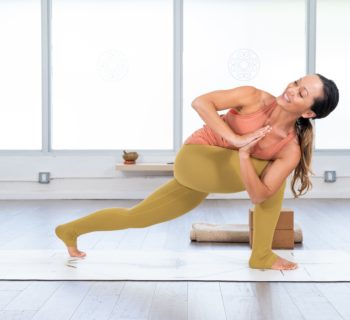
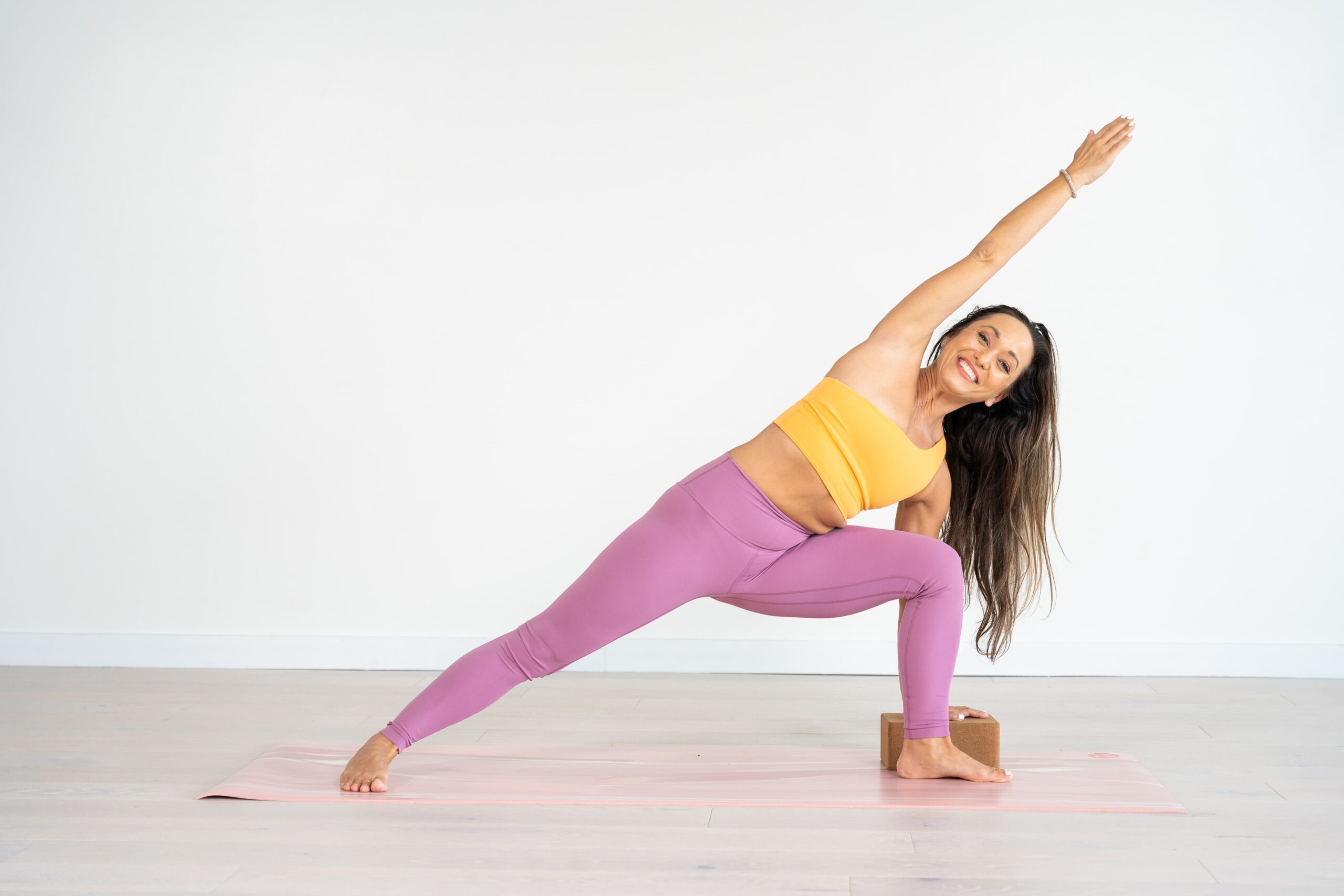
The alignment of Utthita Pārśvakoṇāsana is not a rigid prescription but a field of exploration. Traditionally, the feet are set wide, often the distance of one leg’s length or slightly more, establishing a broad and stable base. As the right foot turns outward, the right hip follows into external rotation, while the left leg grounds and stabilizes. There is a natural tendency for the back hip to drift forward, and for the back foot to collapse into that movement. A subtle internal rotation of the back leg can create a counterbalance, preserving both stability and spaciousness along the lateral body.
Yet even here, there is no single correct expression. For some practitioners, especially those managing sensitivity in the hips, allowing the back hip to turn slightly forward may offer greater comfort and sustainability. For others, maintaining a more open pelvis may prepare the body for deeper expressions encountered later in the practice.
In this way, the pose becomes a dialogue rather than a command. Using the framework of Vīrabhadrāsana II as a reference, the arms extend outward, the torso lengthens, and then arcs over the front leg. The front knee tracks in alignment with the foot, the thigh working toward parallel with the ground, while the back leg remains steady and alive. The lower hand may rest lightly on the floor, a block, or the thigh, while the upper arm extends overhead, creating a continuous line of energy from the back foot through the fingertips. The action of pressing the knee into the arm and resisting that pressure through the shoulder creates an internal integrity that stabilizes the posture from within.
This is the kind of subtle work we explore together inside the challenge, where repetition becomes refinement.
Adaptation is not a deviation from the practice, but an expression of its intelligence. A block beneath the hand can bring the ground closer. The forearm resting on the thigh can provide support while preserving the essential actions of the pose. A chair can transform the posture entirely, offering accessibility while maintaining its structural integrity. Each variation retains the same underlying principles: grounding through the legs, expanding through the side body, and stabilizing through the center.
The breath and the subtle body remain central throughout. In the Aṣṭāṅga method, the gentle drawing in of the lower abdomen supports the movement of prāṇa along the central axis. The pelvic floor, the diaphragm, and the rhythm of inhalation and exhalation become the invisible architecture of the pose. Without this inner engagement, the posture risks becoming merely external. With it, even a simple variation becomes a profound experience of integration.
Across different lineages, variations in hand placement and alignment reflect different intentions. Placing the hand inside the foot may reduce the demand on the hip and allow for greater openness in the chest. Placing it outside may increase the intensity of the fold and the activation of the outer hip. Neither is inherently superior. Each serves a different purpose, and each invites the practitioner to listen carefully to their own body.
What emerges over time is not a perfect shape, but a refined sensitivity. Utthita Pārśvakoṇāsana becomes less about achieving an external form and more about cultivating an internal coherence. It asks how we balance effort and ease, how we remain steady within expansion, and how we adapt without losing the essence of the practice.
And perhaps this is why such a seemingly simple posture holds so much power. It reminds us that the path of yoga is not built on dramatic moments of transformation, but on the quiet repetition of foundational actions, performed with attention and care.
To keep practicing, then, is not merely to repeat a sequence. It is to return, again and again, to these foundational spaces where learning is still possible. It is to trust that even the most familiar posture contains undiscovered depth. And it is to recognize that within the simplicity of standing, reaching, and breathing, the entire path of yoga is already present, waiting patiently to be realized.
If you are ready to return to these foundations, to rebuild from the ground up with clarity and intention, join us inside the Ashtanga Reset Challenge on Omstars.